Station 4
Machine Room
Before entering the noisy machine room, listen to this explanation now. Once you’ve heard the explanation, put on your ear protectors before you go inside. You’ll find the ear protectors before the staircase leading down. Please remember to return the ear protectors after leaving the machine room.
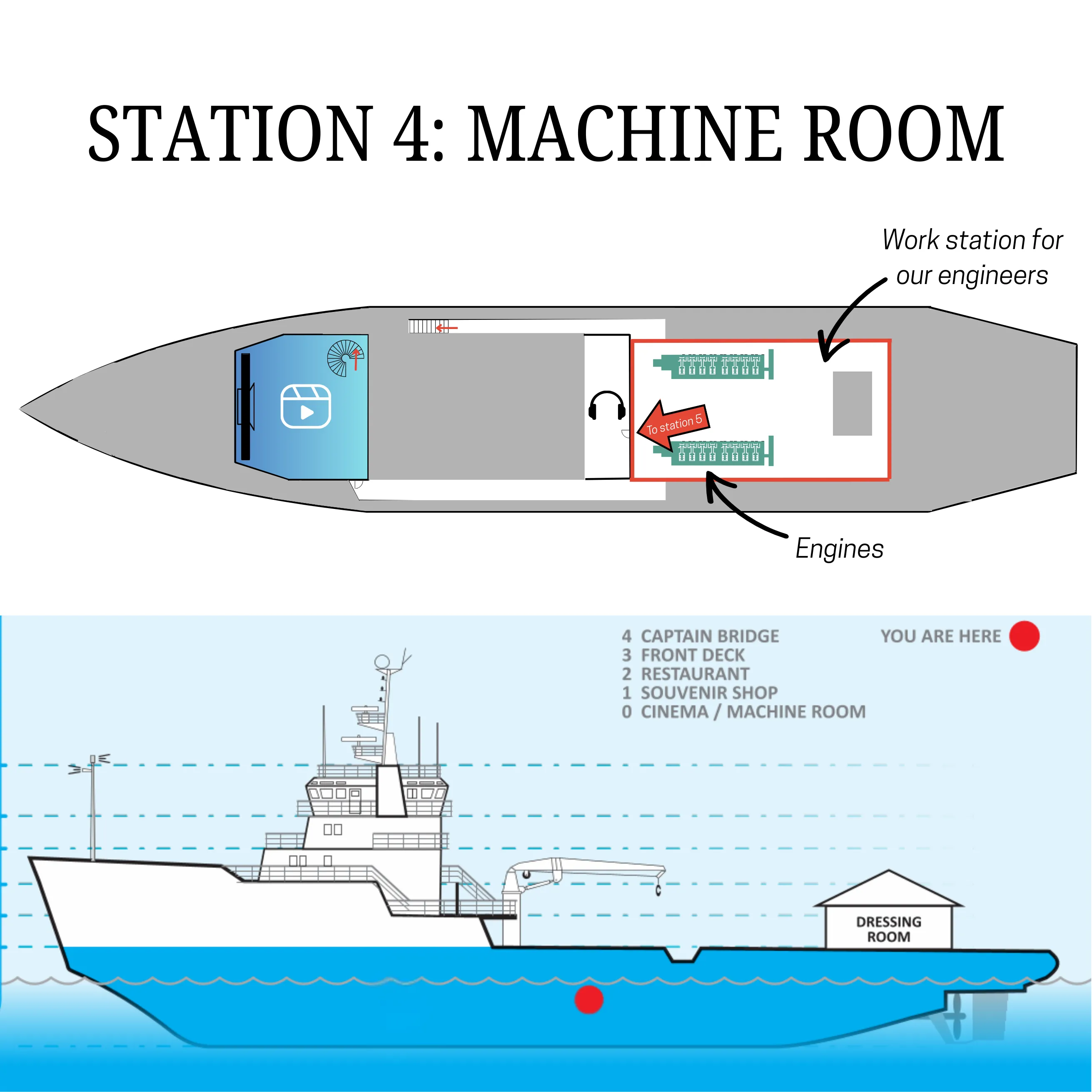
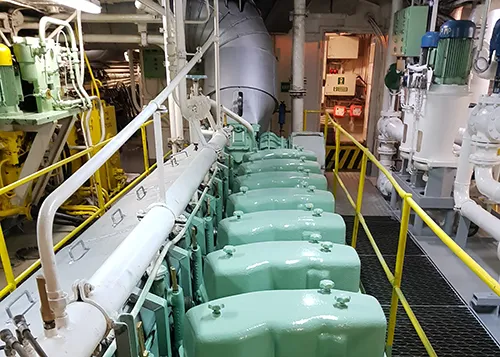
After passing the narrow corridor, on your left, you’ll see 8 green cylinders – this is one of the ship’s two massive engines, manufactured by the German company Mak. The part you see is the top of the engine. The top of the engine has one of the motor heads open, showing the pistons running at their peak. The engine is like an iceberg – you can see only the top. If you look down thought the next floor, you will see the entire body of the engine which is about 4 meters high, 10 meters long and 2 meters wide.
This 8 cylinder-engine alone provides about 4,730 horsepower. In addition to this engine there is an identical engine on the other side of the room. These two engines bring the power of the icebreaker to 9,460 horsepower. A 365-degree thruster of 1,000 break horsepower – the power available at the shaft of an engine – can be used when necessary. Offshore, the thruster is normally mostly on standby. Altogether, the maximum available power is 10,460 horsepower. That’s equal to the power of 77 Toyota Corolla cars or 21,000 Olympic class rowers.
This engine power is needed not only to cut a channel through the ice, but also to carry cargo or pull another ship or an oil rig via the channel.
The fuel used for the icebreaker is diesel. Consumption is 500 litres per hour. There are a few tanks with a total capacity of 984 cubic meters – almost 1,000 tonnes of fuel. We are now moving at a speed 7 to 9 knots. At this speed, over ice that is 1 meter thick, the icebreaker consumes 500 litres of diesel per hour. Imagine that the Polar Explorer can sail continuously though the ice for 1,968 hours. That’s 82 days of non-stop movement and icebreaking! This is a very important feature for ships sailing long distances through difficult icy waters with no possibility to refuel.
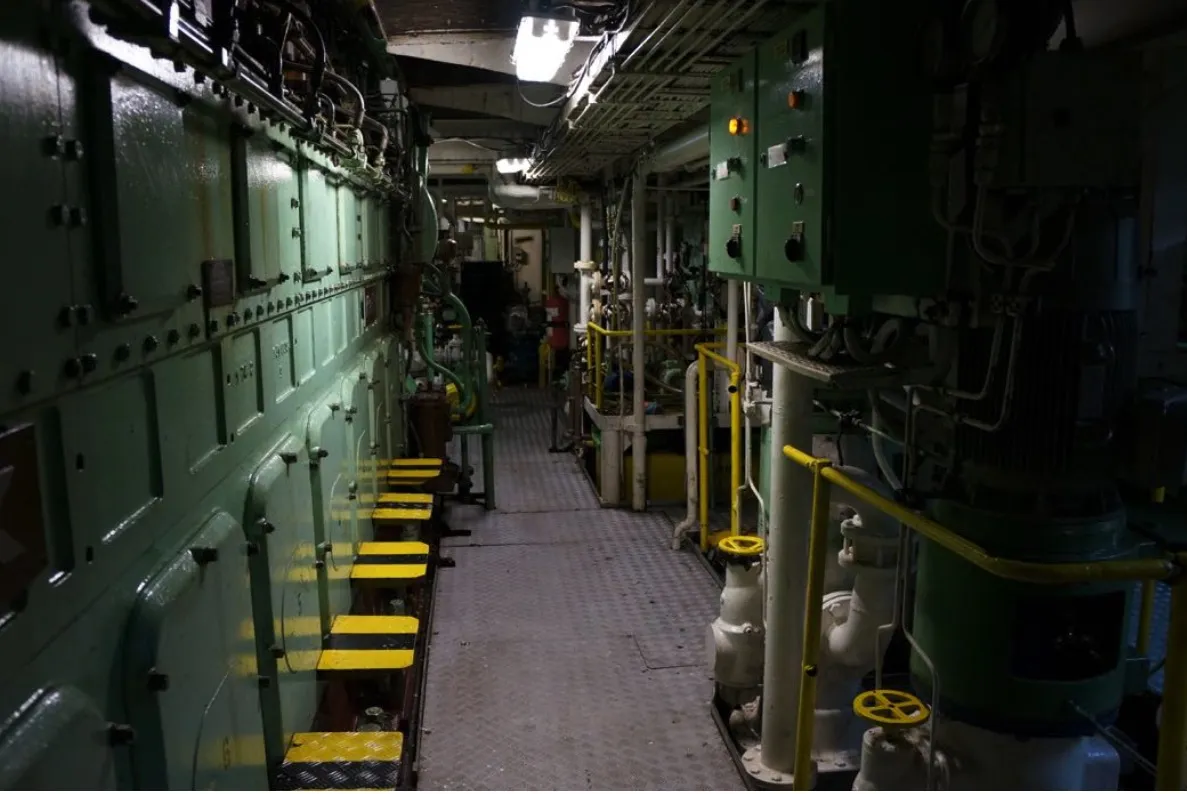
There are two diesel generators and one shaft generator that provide electricity all over the ship. These are located behind each engine.
The white pipes you can see in the middle are the engine cooling system. The system is similar to the kind a car has, but uses only sea water. The same system produces fresh water for daily use.
At the other end of the room is the work station for the engine room staff. It has avariety of equipment to be used in order to repair or manufacture parts while atsea.
In the middle of the machine room you can see a door with a glass window. This is control room. Please proceed through that door to continue the tour.