.webp)

Getting to the icebreaker: the Rovaniemi shuttle and how a day works
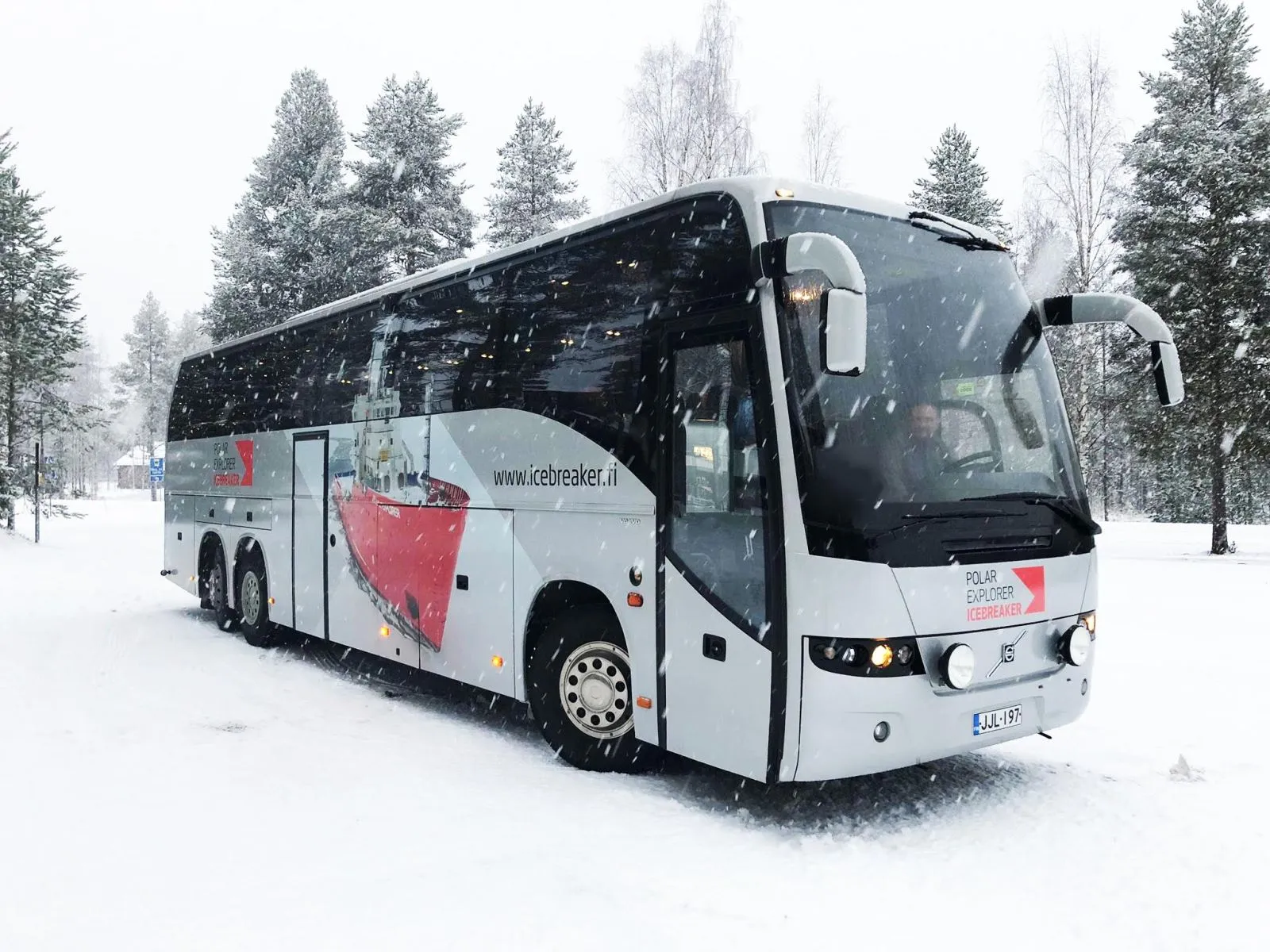
You have booked the icebreaker, or you are about to, and now the practical questions start. Where is the ship, how do you get there from Rovaniemi, how long does the whole thing take, and what actually happens once you are on board?
None of it is complicated, but knowing the shape of the day in advance makes it easier to plan the rest of your trip around it. Here is how it works, start to finish.
Where the ship is
The icebreaker sits out on the frozen Bothnian Bay, the northernmost arm of the Baltic Sea, where the water freezes thick and solid through the Arctic winter. Rovaniemi, the main hub of Lapland, is the practical base most travelers use, and it is where the journey begins.
The ship does not come to a city harbour. You travel out to the ice.
The shuttle from Rovaniemi
A shuttle connects Rovaniemi to the icebreaker, so getting there is something you hand off rather than plan. You travel out together as a group, arrive at the ship, spend the expedition on board, and travel back the same way.
You do not need a car. You do not need to navigate to a remote Arctic harbour on your own. The shuttle is the one logistics question the day answers for you.
The shuttle ride from Rovaniemi takes approximately 155 to 180 minutes each way, depending on your specific hotel pickup point. Please note that the shuttle is booked separately and incurs an extra charge on top of your standard cruise ticket.
Exact pickup points and times depend on your departure and your booking. Confirm them when you book, or check our frequently asked questions for the current details.
Morning or afternoon
There are two departures each day: one in the morning and one in the afternoon. There is no evening departure. Both run the same expedition out onto the frozen sea. If you are trying to decide between them, there is a separate guide to that choice, but for planning purposes the key fact is simple: two slots, you pick the one that suits your day.
What a day on the ice actually looks like
Once you are on board, here is the rough shape of it.
You arrive and settle in.
You board the ship, meet the crew, and get your bearings. The guiding runs in 16 languages, so the story of the ship and the ice reaches you clearly wherever you are from.
The ship breaks out into the ice.
This is the part you feel through the hull: the climb, the crack, the steady push as a real industrial icebreaker opens a path through the frozen sea. Polar Explorer has been doing this since 1976 and is built for exactly this job, 78 metres of ship, 9,460 horsepower, dedicated now to putting explorers on the ice.
You step onto the frozen sea.
When conditions are right, and that call belongs to the captain, not the schedule, the crew helps you down onto the ice itself to walk on it.
You float, if you want to.
The optional ice swim is the part most explorers remember. You put on an insulated survival suit that holds you up on its own, and you float in the Arctic water. No swimming ability is needed, and the crew supervises the whole time.
You warm up.
Back inside, there is somewhere warm to thaw out, with food and drink depending on which ship you are on. Polar Explorer has a full restaurant and cinema on board; Arctic Explorer has a small cafe.
How much time to set aside
The expedition itself runs 3 hours on Polar Explorer and 2.5 hours on Arctic Explorer. Add the shuttle travel on either side and you are looking at a half-day plan minimum, not a quick stop.
Build in the morning or the afternoon for it, and you will not feel rushed. Most people come back wanting to sit somewhere warm and talk about what just happened rather than rush straight to the next thing.
Booking ahead matters
The season is fixed to the winter months, and each day has only two departures. That means slots are finite, particularly in peak weeks. Booking ahead is the safe move, and it lets you lock the date first and arrange the rest of your trip around it.
Secure your expedition dates on our booking page.
Follow the Explorer.