.webp)

How an icebreaker breaks metre-thick sea ice, and why you can walk on it after
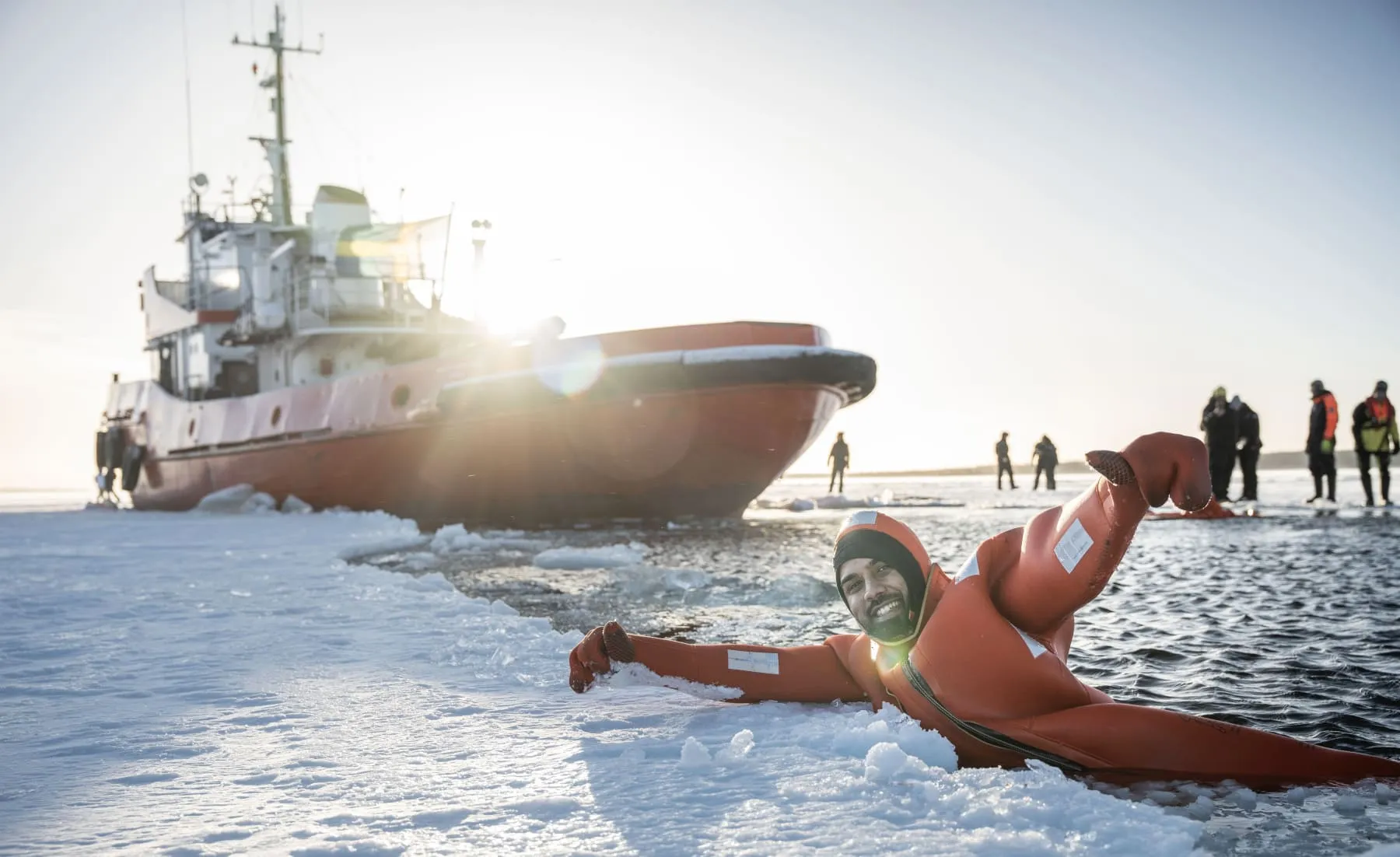
You hear it before you understand it. A low groan through the hull, then a crack like something structural giving way, and the whole ship lifts by a few degrees before settling again. You are standing on the deck of an icebreaker, the frozen Bothnian Bay stretches white in every direction, and the ship has just broken through ice thick enough to stand on.
A few minutes later the crew will help you climb down and stand on that same ice. If both of those things seem like they should not be true at once, this is the article that explains them.
An icebreaker does not cut ice. It climbs it.
The first thing to unlearn is the word "cut." A knife cuts. An icebreaker does something stranger and more clever. Its bow is shaped so that instead of meeting the ice head on, the ship rides up onto it. The hull slides forward and upward until the weight of the vessel is pressing down through a small area of ice, and ice, for all its strength, is brittle.
It holds enormous weight when that weight is spread out flat. It fails fast when a heavy ship leans its whole mass onto one line. The ice breaks downward, the slabs tip and slide under the hull, and the ship moves into the gap it just made. Then it does it again.
That is why the ride feels the way it does. You are not slicing through anything smoothly. You are climbing, pressing, breaking, and settling, over and over. That is where the rhythm and the sound come from. People expect an engine noise. What they get is closer to the sound of the sea itself being opened.
What "a metre thick" actually means
Polar Explorer is a real industrial icebreaker, built in 1976 in Hamburg. It is 78 metres long, has a gross tonnage of 1,976, and runs on 9,460 horsepower. It can break through ice up to a metre thick, and it has been doing exactly that for decades.
A metre of solid sea ice is not a frozen puddle. It is a slab that has been thickening for months through the deep cold of an Arctic winter. It is solid enough to stand on, drive on, and in the right conditions to park vehicles on. The reason the ship can still break it comes back to the climbing technique: the ship is not fighting the flat strength of the ice, it is using its own weight to attack the ice in bending, which is where ice is weakest.
Even very thick ice gives way when something heavy enough leans on it from above at the right angle. The ship is reinforced and powered for exactly that job, featuring a hull with a bow angle of approximately 22 degrees.
Why the sea freezes solid enough to hold you
IIce has a property that surprises most people: its compressive strength is enormous, but it bends and fractures under point loads. A metre-thick slab will hold a person easily, and it will hold a vehicle too, but it will fail under a ship bearing down on it from directly above.
The crew reads the ice before anyone steps on it. The ice walk is a captain's decision, made on the day, based on the actual conditions. When the signal is given, the ice is confirmed safe for explorers on foot, with operations requiring at least 20 cm of solid ice thickness at the point of exit. Not theoretically. Actually.
The sound and the feel of it
The breaking makes a specific sound that almost every guest mentions afterwards. Some describe it as a crack, some as a groan, some as a series of pops. What they are hearing is the fracture propagating through the ice slab ahead of the hull, a sound that exists nowhere else, and that people who have been on the ship once often say they would recognise again immediately.
It is the sound of a real working icebreaker doing what it was built to do.
Why both things are true at once
The ship breaks the ice and you walk on it afterwards because different things are happening in each case. The ship exploits ice's weakness under bending loads. You exploit ice's strength under distributed flat loads.
When you step onto the ice beside the ship, you are spreading roughly 70–80 kg across the soles of your boots. The ice distributes that load easily across the slab. When the ship pushed down from above, the load was concentrated along the hull's contact line. Same ice, very different mechanics.
That is not a paradox. It is physics. The ice walk, the swim, the sound through the hull, they are all part of the same expedition. Book at icebreaker.fi/booking.
Follow the Explorer.