.webp)

When does the Bothnian Bay freeze? Understanding the Arctic ice season
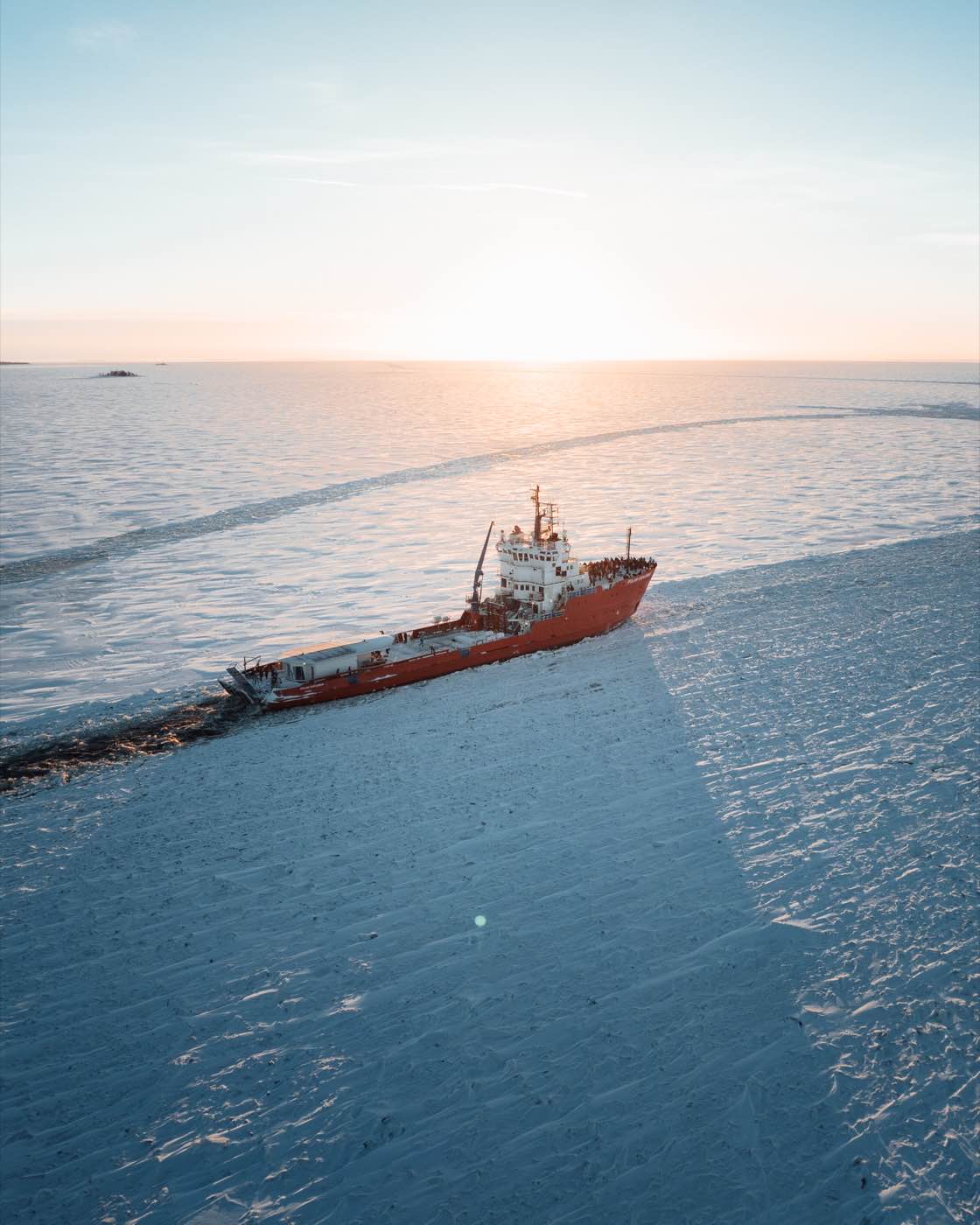
If you want to walk on a frozen sea, you need the sea to actually be frozen. The Bothnian Bay, the northernmost arm of the Baltic Sea, is one of the few stretches of ocean that freezes over reliably each winter. But it does not freeze on a fixed date, and anyone planning an expedition here needs to understand why.
Here is how the ice season works, what drives it, and what it means for planning your time on the frozen sea.
Why a sea freezes here at all
Most of the world's seas never freeze, so it is fair to wonder why this one does. A few conditions line up at the top of the Baltic. The winters run long and genuinely cold. The bay is shallower than the open ocean. And the water carries far less salt than typical sea water, because dozens of rivers feed fresh water into it year-round.
Less salt means the water starts to freeze at temperatures closer to fresh water. Shallow, sheltered water cools faster than a deep, churning ocean. Put those together and you get a sea that turns solid every winter, while seas much further south stay open all year.
How sea ice forms
The freeze does not happen overnight. As autumn cold arrives, the surface water chills until thin ice crystals form. These thicken into a fragile skin, then into a solid sheet that keeps growing downward as the cold deepens. The longer and harder the cold holds, the thicker the sheet becomes, until it reaches the kind of depth you can stand on, drive across, and break through with a real industrial icebreaker.
At peak winter the bay carries ice averaging 50 to 80 cm thick. That is the ice the crew works with every season, monitored closely by national weather experts.
When it actually freezes
The honest answer is that it varies year to year. It depends on conditions, not the calendar. Ice begins forming as early winter cold arrives, builds through the first months of winter, and reaches its most reliable and impressive depth through the middle of the season.
The Polar Explorer icebreaker season runs from 23 November through 14 April. Arctic Explorer runs from 1 December through 31 March. Those windows are not chosen at random: they reflect when the Bothnian Bay delivers the ice the expedition needs. If you want the best chance of thick, walkable ice, the middle of winter is the right part of the season to plan for.
Why "it varies" is not a dodge
It is tempting to want a single date. But sea ice does not work that way, and any source that gives you a fixed freeze date is oversimplifying. Conditions vary between years, and within any season the ice can be thicker or thinner depending on temperatures, wind, and snowfall.
That is why the icebreaker operates on a captain's decision, not a booking guarantee: walking on the ice is confirmed on the day, based on what the ice actually is. What does not vary is the window. Plan for January or February and you are in the part of the season when the ice is most consistently deep.
What this means for planning
The Bothnian Bay will freeze this winter, as it has every winter within living memory. Your job as an explorer is to show up in the right part of the season and let the conditions deliver the experience.
The expedition runs twice daily throughout the season, with morning and afternoon departures. Open dates are listed at icebreaker.fi/booking.
Follow the Explorer.